
On January 19th at 11:48 p.m., my wife Justine and I were welcomed with the birth of another beautiful son – Samuel Thomas. Justine had experienced a difficult delivery of our firstborn, August, two years earlier. So, the fact that Samuel went easy on her made us incredibly grateful that the experience was night and day by comparison. When Samuel came to us, I didn’t realize how much tension I had been holding in which suddenly dissipated. God had answered our prayers: our son was healthy, he came easily, and Justine was alright. Maybe we could even think about having a third child.
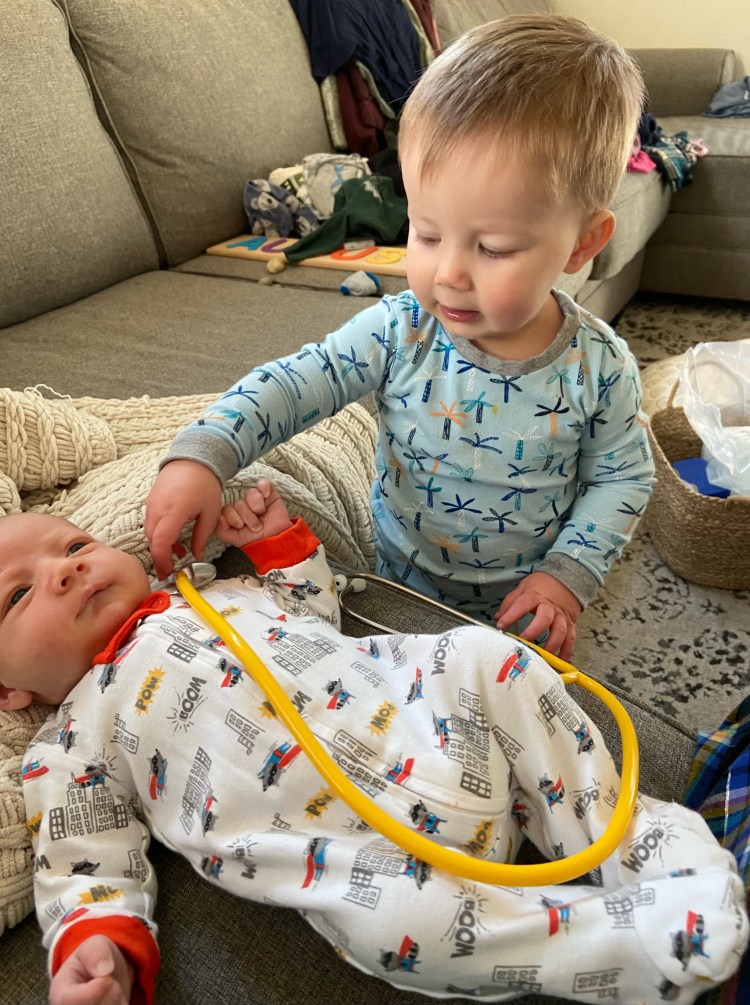
From the hospital, we went home to 4 excited grandparents and an unexpecting 2-year-old brother who wandered where his mother had been. It was such a precious sight to see August hold Samuel for the first time! Imagine a slightly confused, but happy toddler holding his baby brother surrounded by a paparazzi of grandparents on iPhones. It was a precious, one-of-a-kind moment that the Lord had been preparing to bless me with for almost 30 years as he knit our family together. There is just nothing like hearing “Brudder Sammy” in a high register, helium voice from August.
Then last Friday, I got a text from Justine that in part read: “They are sending him by ambulance to Valley Children’s [Hospital] for a fast heart rate. Faster than they have ever heard…could you think about finding someone to look over Augie and come to the hospital with me?” We would all like to think that we would be courageous in moments like this. But to be honest, I just stared and read my wife’s message about 10 times in disbelief.
Leading up to this message, Justine had taken Samuel to his two-week checkup. While taking his vitals, the medical professionals realized that his heart rate was sky high and called for him to be sent to the ER. I have since wondered what would have happened if his check-up was a day earlier or today (Monday). We might have never known there was something wrong until his symptoms had become far more serious at home. Or what if it had been in the middle of the night?
Once the moment registered and our pastor and his wife graciously let me pawn August off on them, I zoomed to the hospital. I confess that I have never burned so much rubber or ran more red lights. When I arrived at the ER, there was a security guard who would not allow me to enter. Because of “Covid restrictions,” only one parent was allowed into the trauma room. I will also confess that I slightly lost my “pastoral touch” in what I said to him. But after going back and forth at the front and with the nurses realizing that I was on speakerphone with Justine, I was allowed back. I got my visitor sticker, went through security, and was then escorted by the nurse to the trauma room. The “trauma room?”
With the perspective of two days, Justine and I have evaluated our responses to this moment. Again, it is one thing to imagine how you would respond. It is another to be confronted with incredible fear of uncertainty – especially when it involves your own child. For Justine, she appeared to me to be quiet, calm, and factual. She describes that behind this demeanor was more of a feeling of an out of body of experience with refusal to think about the worst that could happen. Justine had also seen the intensity of the moment ramp up: from the first nurses’ perplexing demeanor at Samuel’s high heart rate, to the ambulance, to the IV being placed in his arm. For me, I walked into the moment having already been amped up to a ten. It was a sight to suddenly see my 17-day old child hooked up to 100 tubes surrounded by more than half a dozen health professionals – in the “trauma room.” Us, in the trauma room? The same place where other children have died, and parents have been stricken with unimagined with grief? Justine was thinking with the facts before her, with the emotions to come later. I walked in thinking about life and death from the beginning, trying to diagnose how bad the situation was.
Medicine was given to get his heart rate lower. It didn’t work. A higher dose. Still didn’t work. The nurse, who appeared to be more in charge than the doctor on call, assured us that there were more steps. But how many steps? What happens if they run out of steps? Again, how serious is all of this? I began to scan everyone’s facial expressions in the room to get a hint, a glimmer of how they were perceiving the moment. It was so surreal – this one nurse in charge had what I can only characterize as a “jocular” demeanor that didn’t fit the intensity of the situation at all. Upon reflection, it was her command of the moment paired with her attitude that kept everyone calm.
Next up, they were going to use the AED (automated external defibrillator) on Samuel to “reset” his heart rate. They hooked up the pad which seemed to cover his entire, tiny chest. We stood in the corner with arms folded, pretending to look normal despite the chaotic moment. When they shocked him, his little body leapt upward, followed by crocodile tears. But nothing… heartbeat was still too high. One of the nurses even cursed under her breath. In response, the doctor (but really, that one nurse) ordered a second shock, but a higher wattage this time. I moved to the end of the bed to see what has happening. Then, someone told us what steps would be taken if the next shock didn’t work, but the sight didn’t allow the words to register in my mind.
“Clear.” Shock. Again, his chest launched upwards followed by an infant cry and tears.
This time, praise the Lord, his heart rate dipped to 180-200 bpm. Everyone held their breaths to see if these numbers would stick or whether they would begin to climb and we would be back to square one. By God’s mercy, Samuel’s heart rate stayed level and then eventually began to settle down to 130-150 bpm. The on-call doctor moved on to the next crisis, others began to clear out of the room, and we were left to hold our son in the aftermath of a 2-hour whirlwind which had seem to have gone by in only 20 minutes.
We were later told (and you’ll have to pardon me, this will be the most layman description you’ll read. I’m still figuring it out) that Samuel has an “abnormal pathway” in his heart that carries an electrical charge making the heart work much more quickly. Supraventricular tachycardia (SVT). Medication can help keep him level and he might need surgery by the time he’s 7 years old. For the time being, we are to learn how to use a stethoscope to take his heart rate, be mindful of potential symptoms for any future episodes, and do our best to live normally.
* * * * *
As you can expect, I’ve also taken some time to reflect and evaluate where God was in this moment. What was He doing through all of this? What did He think? Of course, why Samuel? What will be the fruit of this? What is He trying to show us? You know, the existential questions.
I have done two things at significant moments in my life that may seem odd to you. Right when I got married, I read Tim Keller’s Walking with God through Pain and Suffering. Amongst many wise insights, Keller prepares Christians for not the if but when of suffering in the life of the believer, who God is in our suffering, and how we may comfort others in their dark hours (I highly recommend reading this if you haven’t read it). Secondly, before our first son was born, I read the book of Job twice. In both cases, as best as possible, I did not want my faith to be shocked to its core if suffering came my way in marriage or in parenthood, but instead wanted to be theologically prepared for the reality of pain that could come. For too many Christians, there is a naivete that God would never allow us to suffer but only wants us to prosper according to our definition of “prosperity.” So, when misery comes knocking, their faith can be utterly devastated: “I thought God was loving. Why would he do this to me?” In other words, a failure to prepare for suffering comes at the peril of our faith.
Here is how I see things, both for Samuel in that trauma room and for all who suffer. There are three options that we have before us when we encounter suffering: Satan is in charge, no one is in charge, or God is in charge.
Consider the first option. If we say that the devil is the lord over our suffering, then we can have no comfort. He is the wicked architect who can bring despair down upon us as he pleases, and we are at his mercy. Second, if no one is in charge, then my suffering and yours has no ultimate purpose (telos). We may try to ascribe personal meaning to what has happened, but at bottom, there is the despair of knowing that the snuffing out of innocent life, the unexpected betrayal and loss of a deep relationship, or the botched surgical procedure that alters one’s quality of living can only be attributed to mindless, unfortunate chance. Which is worse: knowing that the Enemy is pulling the levers to your despair or knowing that your random suffering for the few seconds you’re here on earth is actually meaningless? I believe that both options, if taken seriously, can only lead to hopelessness.
However, there is a third option: God oversees our suffering – in such a way that He remains morally guiltless for permitting it to happen in our lives and yet accomplishes it for his glory and our ultimate joy. In the book of Job from Scripture, Job is completely innocent of the calamity that comes upon him. In a moment, his family, livelihood, and health are all taken away (see Job 1-2). How does Job respond? He says, “Naked I came from my mother’s womb, and naked shall I return. The Lord gave, and the Lord has taken away; blessed be the name of the Lord” (1:21. See further on Job’s perception of who caused his calamity 2:10; 12:9; 16:6-17; 19:21; 30:19-21). In Job’s mind, God clearly was the overseer of what had happened to him.
Moreover, though it is Satan who is the means to accomplish Job’s calamity, it is the Lord who gives him permission twice (1:12; 2:6); it is the “fire of God” that fell and destroyed Job’s livestock and servants (1:16); finally, when Job is restored at the end of the story, the narrator states that his friends and family came to him and “and comforted him for all the adversities that the LORD had brought on him” (42:11. NASB). If this feels wrong to you, take it a step further and consider that Job is never told the reason for his suffering. The reader gets a bird eye view into the heavenly court contest between the Lord and Satan as the fate of Job is decided. In fact, the response that Job gets to his demand to present his case before God (13:3, 15-19; 23:3-7; 31:35-37) is the thunderous answer in the storm theophany from God himself: “Who is this that darkens counsel by words without knowledge? Dress for action like a man.” Keller characterizes this response to Job: “The Lord is God –and you are not!” These are hardly the kind of words you would expect from a grief counselor let alone the one who claims to be our “Shepherd” (Ps. 23).
The truth is that our preferred depiction of the Lord would be of a God who never allows anything bad to happen to us. The problem is that such a preference not only fails to correspond to our lived experiences (Christians do in fact, suffer), it does not fit the revelation of God from Scripture, with the Job story as a chief example. This is where I first found Keller helpful in my interpretation of the Job story. How is God fair in allowing Job to be an innocent sufferer and then never pulling back the curtain to show him what had been happening behind the scenes? By pointing to the Lord’s answer (ch. 38-41), Keller shows that when we bring our self-justification projects before the Lord, we are shown to be unworthy before a holy Judge. There is only one Creator and Sustainer of life, nature, and seasons who in His wisdom has the right to do what He pleases. He does not owe us an answer. And yet, by grace he does answer us, through his Word that became flesh, “the other innocent Sufferer,” that the Job story points leads us to: Jesus.
“…we need to know that Jesus Christ bowed his head into the greatest storm–the storm of divine justice–for us, so we can hear a voice of love from the holy God. He took the condemnation we deserve so God can accept us. For Jesus is the ultimate Job, the only truly innocent sufferer. …As Job was ‘naked,’ penniless, and in physical pain (Job 1:21), so Jesus was homeless, stripped, naked, and tortured on the cross. While Job was relatively innocent, Jesus was absolutely, perfectly innocent, and while Job felt God abandoning him, Jesus actually experienced the real absence of God, as well as the betrayal of his foolish friends and the loss of family… when you suffer without relief, when you feel absolutely alone you can know that, because he bore your sin, he will be with you. You can know you are walking the same path Jesus walked, so you are not alone – and that path is only taking you to him.”
Dear friend, there is a part of me that remains perplexed that God would “duel” it out with Satan in a heavenly court over Job’s life. I do not know why you may have gone through unbearable tragedy. I do not know why God allows close friends to feel betrayed by each other after years of friendship. I do not know why God allows a husband to abandon his new wife after a short period. I do not know why a friend of mine’s wife has a terminal illness. For myself, I do not know why these last few days have turned my family upside down – why Samuel’s heart is the way it is, why we had to see him be shocked by an AED, or why we will have to go through whatever twists and turns that could come (barring miraculous deliverance, which is certainly possible). Could there be another episode this week? Next month? Never?
I do not know the answer to the why questions, but I do know where to point myself and you, dear friend: to the cross. That is all that I know or desire to know (1 Cor. 2:2). The cross is the guarantee that the truly Innocent Sufferer, The God-Man, comprehends our suffering and can counsel us through it, since he has tasted death himself. “For because he himself has suffered when tempted, he is able to help those who are being tempted” (Heb 2:18). The cross is the guarantee that while this Innocent Sufferer was forsaken for you, he will never forsake you in your time of need (Heb. 13:5). And most importantly, the cross is the guarantee for us that death does not have the final word. For the One who has said that we are to “cast our burdens upon him” and who is “gentle and humble” towards us, is also the One who has overcome the grave and our sin. Do you despair? See Jesus, your older brother who through His resurrection has provided the foretaste of the life to come if we are found in Him.
I’ve heard a preacher say that there is not one person too strong who isn’t capable of being put in the fetal position by one tragic phone call. Despite all the Instagram reels I see about taking control of your life, the truth is that we don’t have a clue. This is why it is better to trust God than ourselves, because He alone is the good and sovereign Judge. In the end, it is better to be in the Lord’s hands than that of Satan, fate, or our own. In His strange but good providence, when suffering comes, He will not allow one thing to happen to you that He has not permitted, nor will He waste what happens but will use it to point you to Himself while He stands in the fire with you. In the face of suffering, this allows us to stand with the conviction of one famous missionary who has said, “I have a firm conviction that I am immortal until my work is done.”
I was in the trauma room with Samuel on Friday. But God fulfilled the meaning of my son’s name when we were there: God has heard. He heard us and delivered us. But most importantly by His Spirit He was with us and will continue to be with us for whatever comes next. Amen. Come Lord Jesus.
 Aaron Garza
Wow! Thank you for sharing!
LikeLiked by 1 person
Very powerful. I was praying for your family . God is amazing in the midst of utter chaos especially in my line of work . Blessing to you, your wife and 2 beautiful baby boys .
Please keep writing.
LikeLiked by 1 person
Beautifully written.
So sorry for your heartache from this experience, but God is already using it to give guidance and blessings to others who are in or will experience hurting circumstances. May God bless little Samuel with a strong heart, a strong and loving life for our Heavenly Father.
LikeLiked by 1 person
Thank you for putting your thoughts down in paper. It has already encouraged many and someday Samuel will better understand how faith in God will bring peace in troubled times.
LikeLiked by 1 person