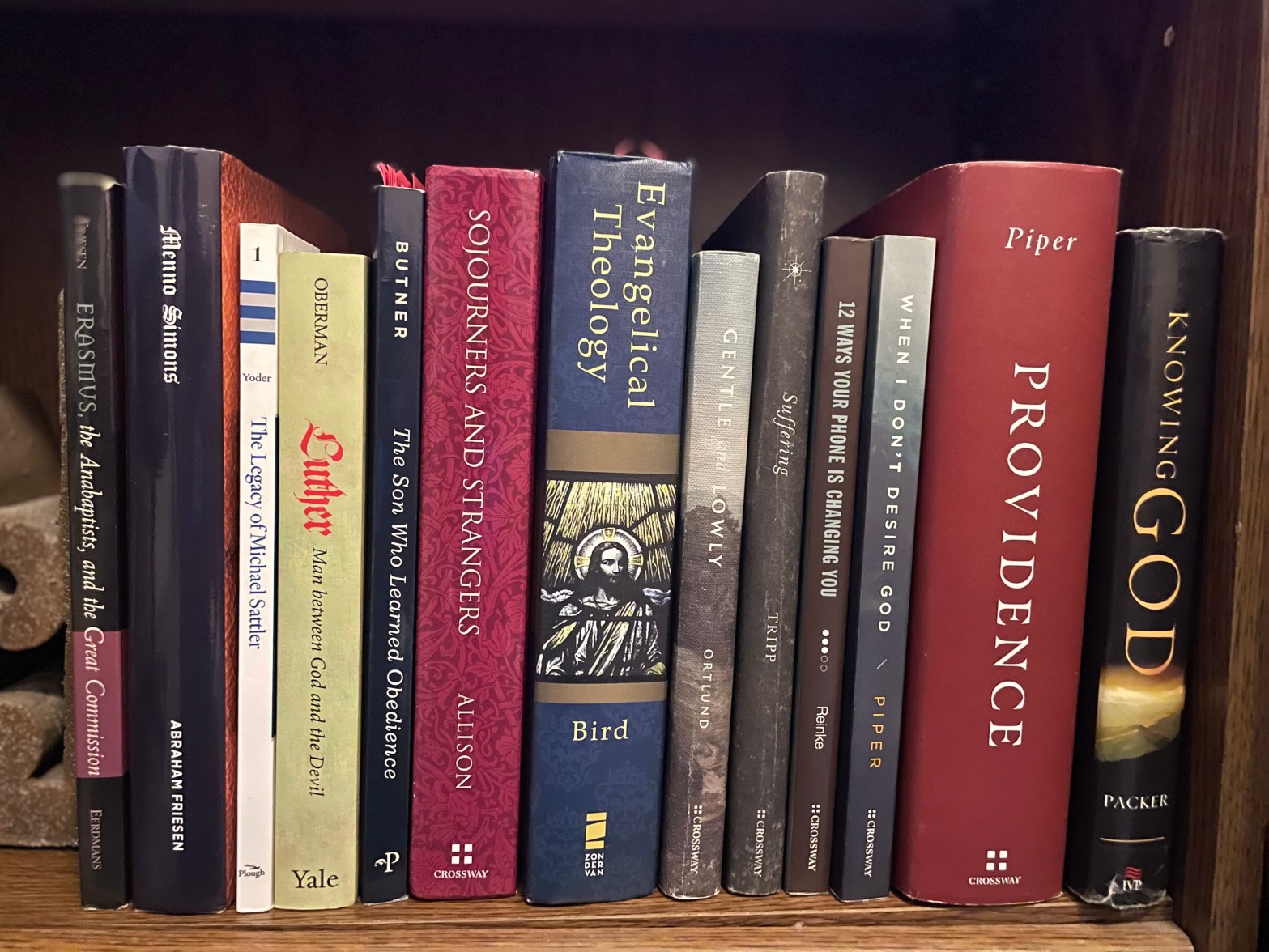
Part of starting a new website means getting the opportunity to recommend what I’ve been reading in both my academic doctoral studies (in systematic theology and the Protestant Reformation) and in my devotional life. I know. I know. I’m late to the game here. Nevertheless, here are my favorite reads from 2021:
Erasmus, the Anabaptists, and the Great Commission, by Abraham Friesen
This short work by Friesen has been instrumental in my doctoral study to show how many of the early 16th century Anabaptist reformers were impacted by the work of the Dutch humanist, Desiderius Erasmus. It is true that the Anabaptists reclaimed the proper view of believers baptism through their reading of Scripture, but it was Erasmus who laid the foundation work for them through his Greek translation of the New Testament and Annotations. In other words, you can’t appreciate the “evangelical Anabaptists” (to use George H. William’s term) and their reading of the Bible without seeing the scholarly impact of Erasmus upon them. Fascinating!
Menno Simons: Dutch Reformer between Luther, Erasmus, and the Holy Spirit, by Abraham Friesen
This second work here is also by Friesen. In his profile of Menno Simons, through whose namesake various groups of Mennonites still exist today, Friesen rehearses previous scholarship and provides the most up to date biography on the Dutch Anabaptist. If you have ever wondered about the man who stands at the fountainhead of the Mennonite tradition, Friesen’s work is a great place to dive in and builds upon Erasmus, the Anabaptists, and the Great Commission mentioned above.
The Legacy of Michael Sattler, by John Howard Yoder
It is unfortunate these days that a reference to any work from Yoder also necessitates an acknowledgment of his horrendous ethical behavior (I’ll leave the reader to do a quick google search to see further). Nevertheless, the window provided into the life of Michael Sattler, particularly his martyrdom account is both sobering as much as it is inspiring.
Luther: Man Between God and the Devil, by Heiko Oberman
This is the fourth biographical/theological overview treatment I have read on Martin Luther. As the subtitle suggests, Oberman gives an insight to the inner religious turmoil or terror (known as his anfechtungen) experienced by the German Augustinian monk and its impact in his journey to rightly understanding the doctrine of justification by grace through faith. While many treatments provide helpful overviews of Luther’s theology and major life events, with Oberman, one senses when finished reading this work that you understand Luther the man.
The Son Who Learned Obedience, by D. Glenn Butner
Next to my doctoral supervisor, Malcolm Yarnell, and his God the Trinity: Biblical Portraits, Butner’s The Son Who Learned Obedience has been the most formative work I have read on the doctrine of the Trinity. Although it isn’t light reading, Butner’s contribution is found in getting the reader up to date on the current debates theologians are having on the doctrine of the Trinity as well showing the validity of the Pro-Nicene and Chalcedonian understandings of the Trinity and the Person of Christ.
Evangelical Theology: A Biblical and Systematic Introduction, by Michael Bird
On the popular level, the most well known evangelical theology probably still is Wayne Grudem’s Systematic Theology. However, after reading Bird’s system, I am convinced that this is a far better starting point for those who want to be introduced to the field of systematic theology. Although Bird is an Anglican, and so I obviously disagree with his views on infant baptism and some other ecclesiological points, he is also a trained biblical theologian. Therefore, the merits of Evangelical Theology are in its solid treatment of various biblical passages’ context and the narrative elements of Scripture.
Moreover, Bird’s consultation of historical theology in forming his doctrinal conclusions provides the new reader in theology an excellent introduction to various Christian views throughout church history . While some Anabaptists from my own tradition tend to be rightly skeptical of certain systematic theologies for making “square pegs fit into round holes” (forcing biblical texts fit neatly into one’s theology), with Bird one is in safe hands that the theology presented here accurately reveals the doctrine of Scripture itself.
Gentle and Lowly: The Heart of Christ for Sinners and Sufferers, by Dane Ortlund
This book by Ortlund was by far my favorite read from 2021 (I read it twice!). Here’s a great quote that explains what Gentle and Lowly is all about: “The message of this book is that we tend to project our natural expectations about who God is onto him instead of fighting to let the Bible surprise us into what God himself says” (pg 155). If you live your Christian life with the sense that God is just constantly slightly disappointed with you or doubt the incredibly compassionate heart that Christ has for you, read this book!
Suffering: Gospel hope when Life Doesn’t Make Sense, by Paul David Tripp
Here’s a great rule: if Paul Tripp has written something, you should read it. The advantage of Suffering is in its clear, straightforward presentation. Tripp personally went through incredible physical suffering from surgery after surgery, and so provides the reader with insights from his own journey interwoven with an explanation of the gospel’s powerful effects in sustaining the believer through his or her own dark hour. Are you suffering? Read the last two books mentioned and be blessed.
12 Ways Your Phone is Changing You, by Tony Reinke
Reinke’s book gets the award for being the most convicting for me on this list. More than anything, Reinke shows the idolatry that lies behind, for example, our aimless scrolling on our phones at the late hours of the night. In doing so, he also provides helpful strategies so that we would be more productive servants of Christ than slaves to technology.
When I Don’t Desire God: How to Fight for Joy, by John Piper
If you’ve read Piper, you know that almost every one of his works builds upon his concept of “Christian hedonism.” This comes through in his oft used statement that “God is most glorified in us when we are most satisfied in him.” However, the question this book seeks to answer is: what about when we don’t desire God even when we know we should? On a devotional level, I found When I Don’t Desire God to be rewarding in answering the question. If anything, the many C.S. Lewis quotes throughout are worth the price!
Providence, by John Piper
At over 700 pages, Piper’s tome may seem quite intimidating. However, its readability makes it easy to mow right through. I began reading Providence asking the question: how pervasive is God’s providence in my life let alone human history? Through surveying the Bible’s presentation of God’s providence in creation, the history of Israel, natural and supernatural realms, over governments, life and death, over sin, conversion, Christian living, and the end of all things, Piper answer this question: God is all-pervasive over every moment in human history in such a way that He mysteriously remains good in accomplishing his plan for our benefit and his glory. If you want the full Piper, read Providence.
Knowing God, by J.I. Packer
Last but certainly not least, is this classic by J.I. Packer. Early on, I noticed that most of the Christian leaders I began to admire in my early Christian walk more often than not had Knowing God in their top ten reads. This year, I finally got around to reading it all the way through. How is it that God can be loving but also the Judge of the universe? How is it that He can be the most gracious Being ever but yet also have incredible wrath and jealousy? It is these attributes along with God’s majesty, wisdom, truth, immutability etc. that Packer uses to show how Scripture reveals our incredible God. After walking through these attributes, Packer then brings the reader to the “summit,” that is Romans 8, to show how this this awesome, worthy God is for us by grace and that nothing can separate us from the love of God that is in Christ Jesus our Lord.
 Aaron Garza